God is our Guide                 Number 1 site for helping reverse diseases on Planet Earth
cidpUSA Foundation

 cidpusa.org   


      Home
      Diagnosis
      Treatment
      Pathology
      Variants
      CIDP info
      Fibromyalgia
      IVIG
      Diet anti-inflammatory
      Burning  Feet Home
      Services Page
      Chronic Fatigue
      Autoimmune diseases
      Prognosis
      Bible healing
      Celiac disease
Bible page

Autoimmune self attack

What is autoimmune

Autoimmune types

Autoimmune Guide

Autoimmune Risk

Autoimmune Rx

Autoimmune anemia

Autoimmune Ear

Autoimmune Thyroid

Autoimmune Fiber

Autoimmune Muscle

Autoimmunity summary

Autonomic Small Fiber

Myasthenia Holistic

Polymyositis

Dematomyositis

Poly Dermato

Myositis

Myasthenia alternative

Myofacial pain

Myopathy

Fibromyalgia

Inner Ear Disease AIED

 
  Natural Makeup
  Neck Pain
  Ocular Female diseases
  Chronic fatigue syndrome
  Osteoporosis
  Women Heart Attacks
  Breast Size & Disease
  Female Sex Disease
  PARKINSON
  Memory problems
  Breast Lymph Drainage
  Kidney stone Buster
 Bras cause breast cancer
  Skin repair Clinic
 Pandas
  Hepatitis


Risk of heart disease & stroke 

Depression and breast cancer

Kidney stone removal 

Alopecia general

Personality

Eye Clinic

Skin hair nail spa

Memory clinic

Depression & anxiety

Addiction  & Drug Rehab

Sexual  disorders Clinic

Parkinson Clinic

Epilepsy Clinic

Pain Clinic

Bone disorders clinic

Joint disorder clinic

Skin repair clinic

Gene Manipulation

Neurology Clinic

TMJ Clinic

Reduce  your weight

Antibiotics

 Want more sex

 Vitiligo 1

Eliminate risk of heart disease & stroke 

Memory clinic

Drug reaction prevention

Prevent Osteoporosis

Some rheumatic disorders

Alopecia treatment

Bald Facts

Alopecia

Areata Alopecia

Hair chemicals

Hair rejuvenation

Nail Fungus

SESAME SEED OIL

Facial  cleaner

oil pulling

 Reading disorders

 Best New Diet

 DHEA Fountain of Youth

Parkinson

Diabetise-2

Do not give tots cold medicine 

neurological effects of CIDP

Body goes against the grain

Celiac disease Info

Anemia and celiac disease

 Sex clinic

Everything about IVIg, Home to IVIg

Fatty acids in autoimmune diseases

News

Multifocal neuropathy

Dermrmatomyositis

 
 Link to Articles

 www.cidpusa.org/P/ivig.htm


 Information on Autonomic Nervous system and Cranial nerves


For a complete simple guide on complete treatment of autoimmune disease by alternatives please read our e-book

  •  

   See our services section for help and contact information.

continued from the  Brain Page of Nervous System


Contents

neurons and Nerves
neurotransmitter
The Brain & Spinal Cord
Cranial Nerves
Peripheral Nervous System
Autonomic Nervous System
Senses: Eye diagrams, Hearing, Smell, Taste, Taste & Tongue Sensation, Balance
Memory , Memory types, Creation of Memory,
Higher Functions
Altered States
 

[Top]

Continued from Brain


 Continue to next page the cranial nerves
 

Cranial Nerve CN# Brain Region Major Functions
Terminal§ 0 Near the olfactory Reception of pheromone for sex
Olfactory 1 Cerebral Cortex Smell
Optic 2 Limbic System Vision
Oculomotor 3 Midbrain Eyelid & eyeball movement; pupil dilation
Trochlear 4 Pons Control downward & lateral eye movement
Trigeminal 5 " Chewing; sensation of face & mouth
Abducens 6 " Control lateral eye movement
Facial 7 " Control most facial expressions; secretion of tears & saliva; taste; ear sensation
Auditory 8 Medulla Hearing; balance
Glossopharyngeal 9 " Taste; swallowing; sensation from tongue, tonsil, pharynx, carotid blood pressure
Vagus 10 " Sensory, motor and autonomic functions of viscera - glands, digestion,
heart rate, breathing rate, aortic blood pressure
Spinal Accessory 11 " Controls muscles used in head movement
Hypoglossal 12 " Controls tongue movements

Table 03 Functions of Cranial Nerves

§ The exact function of the terminal nerve in human is still under investigation, which is hampered by its small size and proximity to the olfactory nerve. For mouse and other animals at least, it is connected to the vomeronasal organ (vestige in human), which leads to a pathway for controlling sexual arousal.

 
Spinal Nerve(s) Innervated Body Part(s) Symptom(s) of SCI
C1 Head and Neck Quadriplegia
C2-C4 Diaphragm Breathing problem
C5 Deltoids, biceps No control at wrist or hand
C6 Wrist extenders No hand function
C7-T1 Triceps, hand dexterity problems with hand and fingers
T2-T8 Chest muscles Paraplegia, poor trunk control
T9-T12 Abdominal muscles Paraplegia
Lumbar and Sacral Leg muscles, bowel, bladder, sexual organs Decreasing control of hip flexors and legs, dysfunction of bowel, bladder, and sex

Table 04 Symptom(s) of Spinal Cord Injury

Note: Other effects of SCI may include low blood pressure, inability to regulate blood pressure effectively, reduced control of body temperature, inability to sweat below the level of injury, and chronic pain.


[Top]


Autonomic Nervous System

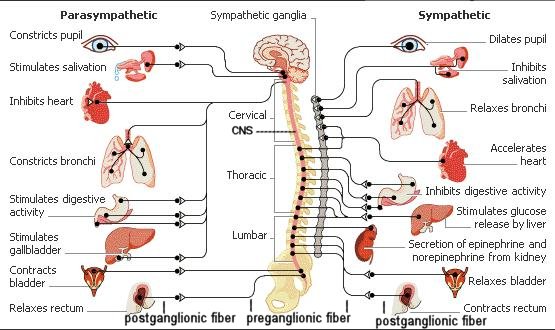
ANS Side View One division of the autonomic nervous system, called the sympathetic nervous system, dominates in times of stress. It controls the "fight or flight" reaction, increasing blood pressure, heart rate, breathing rate, and blood flow to the muscles. Another division, called the parasympathetic nervous system, has the opposite effect. It conserves energy by slowing the heartbeat and breathing rate, and by promoting digestion and elimination (of waste). Most glands, smooth muscles, and cardiac muscles constantly get inputs from both the sympathetic and parasympathetic systems. The CNS controls the activity by varying the ratio of the signals. Depending on which motor neurons are selected by the CNS, the net effect of the arriving signals

Figure 07 ANS Side View [view large image]

will either stimulate or inhibit the organ. Figure 07 shows the various organs and actions, which are related to the two different divisions.
Motor fibers that govern involuntary responses, do not lead directly to the organs they innervate. Instead, they make their trips in two stages. The first set of fibers leads from the CNS to ganglia (which are collections of nerve cell bodies) that lie outside
ANS Front View the CNS (the preganglionic fibers). At the ganglia the fibers form synaptic junctions with the dendrites of as many as twenty different cell bodies. The axons of these cell bodies form a second set of fibers, the postganglionic fibers. It is these postganglionic fibers that lead to the organs.

The chief ganglia involved in the autonomic nervous system form two lines running down either side of the spinal column. They are outside the bony vertebrae. These two lines of ganglia outside the column resemble a pair of long beaded cords. At the lower end, the two cords join and finish in a single central stretch. These lines of ganglia are sometimes called the sympathetic trunks (used by the sympathetic nervous system). Not all ganglia are located in the sympathetic trunks. Some are not; and it is possible for a preganglionic fiber to go right through, making no synaptic junction there at all, joining instead with ganglia located in front of the vertebrae. For the parasympathetic nervous system, some of the ganglia separating the preganglionic fibers from the postganglionic fibers are actually located within the organ the nerve is servicing. In that case, the preganglionic fiber runs almost the full length of the total track, whereas the postganglionic fiber is at most just a few millimeters long.

The splanchnic nerves, which originate from some of the thoracic nerves, have their preganglionic fibers ending in a mass of ganglia lying just behind the stomach. It represents the largest mass of nerve cells that is not within the CNS and is sometimes called the "abdominal brain". It is a vital spot to be protected during boxing.

Figure 08 ANS Front View [view large image]

Figure 08 is the front view of a more detailed ANS anatomy.


[Top]


Senses

Senses Cerebrum Mapping Senses organs receive external and internal stimuli; therefore, they are called receptors. Each type of receptor is sensitive to only one type of stimulus as listed Table 05, while Figure 09 shows many types of receptors. When a receptor is stimulated, it generated nerve impulses that are transmitted to the spinal cord and/or the brain, but we are conscious of a sensation only if the impulses reach the cerebrum.

Figure 09 Senses
[view large image]

Figure 10 Cerebrum Mapping [view large image]


Receptor Type Sense Stimulus
General      
Ruffini's endings, Krause end bulbs Radioreceptor Hot-cold Heat flow
Merkel's and Meissner's endings Mechanoreceptor Touch Mechanical displacement of tissue
Pacinian corpuscles Mechanoreceptor Pressure Mechanical displacement of tissue
Free nerve endings Chemoreceptor Pain Tissue damage
Proprioceptors Mechanoreceptor Limb placement Mechanical displacement
Special      
Eye Radioreceptor Sight Light
Ear Mechanoreceptor Hearing Sound wave
Olfactory cells Chemoreceptor Smell Chemicals
Taste buds Chemoreceptor Taste Chemicals

Table 05 Receptors


The general receptors distribute all over the skin. They are usually grouped together as sensation. The special receptors locate only at certain part of the body in the head. Altogether, they are referred to as the five senses. The followings present a further break down into components, and functions.

continue to Eye diagrams
  

   World Wide Consultation by Internet


Tremor

Top Foods

Treatment of Myasthenia

Trends in medicine 

Ulcerative colitis 

Ultrasound

Everything about IVIg, Home to IVIg

Fatty acids in autoimmune diseases

Small fiber neuropathy 

Depression and breast cancer

Dermatomyositis

Fighting with spouse gets good results!

Vitamin D  deficiency causes high BP

 Mobile phone Use Increases Tumour Risk

New Psoriasis Rx       LasiK Dangers

No cold meds to kids, says FDA

Calcium supplements cause stroke in women

Vitamin D extends life   Breast Size & disease

More Young Women Dying Of Heart Disease

By pass heart surgery

 Reverse Chronic Fatigue syndrome & Fibromyalgia, 


BPA in infant bottles a concern

Want more sex

 Boy or Girl   Autism & Mercury

 Before getting child vaccination read this

 Parents rejecting dangerous vaccine 

Botox causes deaths also in children

Autoimmune reaction kills teenager in breast surgery

Parkinson Prevention    Aids Vaccine alert

Folate Deficiency Triples Risk of Dementia

DHEA levels and cognitive functions

SESAME SEED OIL

Facial  cleaner

 Quran page