Wagner's granulomatosis
Wegner's Guide to symptoms, diagnosis & treatment Wagner & Wegner are two distinct conditions
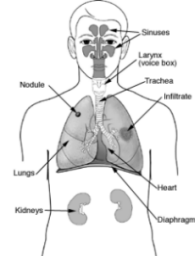
Wegner's granulomatosis is an uncommon disease, in this the blood vessels are inflamed (vasculitis). This inflammation damages important organs of the body by limiting blood flow to those organs and destroying normal tissue. This is also called Wegener's or Klinger- Wegener syndrome.
For Wagners syndrome which is a distinct eye disease please see this page.
Although the disease can involve any organ system, Wagner's granulomatosis mainly affects the respiratory tract (sinuses, nose, trachea [windpipe], and lungs) and kidneys. This disorder can affect people at any age and strikes men and women equally. It is rare in African Americans compared with Caucasians.
An estimated 0.5 to 1% of the world population is epileptic, some with completely unknown etiology and no effective treatment. Epilepsies have long been viewed as diseases of the central nervous system (CNS), but in recent years, evidence has mounted that some may actually be autoimmune-mediated. If so, the way we regard and treat these epilepsies may require a revolutionary change.
The cause of Wagners is autoimmune. Please read the link on autoimmune disease. This condition is fully reversible complete antibiotic protocol in our e-book above.Symptoms
The first symptoms of Wegener's granulomatosis are often vague and frequently include upper respiratory tract symptoms, joint pains, weakness, and tiredness.
Upper respiratory tract
The most common sign of Wegener's granulomatosis is involvement of the upper respiratory tract, which occurs in nearly all patients. Symptoms include sinus pain, discolored or bloody fluid from the nose, and, occasionally, nasal ulcers. A common sign of the disease is almost constant rhinorrhea ("runny nose") or other cold symptoms that do not respond to usual treatment or that become increasingly worse.
Rhinorrhea can result from nasal inflammation or sinus drainage and can cause pain. A hole may develop in the cartilage of the nose, which may lead to collapse (called saddle-nose deformity). The eustachian tubes, which are important for normal ear function, may become blocked, causing chronic ear problems and hearing loss. Bacterial infection can cause Wegener's-related sinusitis (inflammation of the sinuses) with congestion and chronic sinus pain.
Lungs
The lungs are affected in most people with Wegener's granulomatosis, although no symptoms may be present. If symptoms are present, they include cough, hemoptysis (coughing up blood), shortness of breath, and chest discomfort.
please continue to next page of Wegners Symptoms