Beating Diabetese
Department of Pathology and Immunology, Washington University School of
Medicine, St. Louis, MO 63110, USA. anish@pathology.wustl.edu
Type 1 diabetes mellitus results from the autoimmune destruction of the beta cells
of the pancreatic islets of Langerhans and is recapitulated in the nonobese diabetic
strain of mice. In an attempt to rescue islet loss, diabetic mice were made
normoglycemic by pancreatic islet cell transplantation from normal mice and immunization with Freund's (Freund's Complete Adjuvant (FCA), a mixture of a non-metabolizable oil (mineral oil), a surfactant (Arlacel A), and mycobacteria (M. tuberculosis or M. butyricum) has been used for many years to enhance immunologic responses to antigens, and even today is considered to be one of the most effective adjuvants. It is prepared as a water-in-oil emulsion by combining one volume FCA with one volume aqueous antigen solution. In the emulsion, Ag is distributed over a large surface area thereby increasing the potential for interaction with relevant cells. Antibody production is enhanced by FCA primarily because of: a) the depot effect and b) nonspecific immunopotentiation of macrophages by surfactant and the mycobacteria. )
complete adjuvant along with multiple injections of allogeneic male splenocytes. (A splenocyte can be any one of the different white blood cell types as long as it is situated in the spleen or purified from splenic tissue)
This treatment allowed for survival of transplanted islets and recovery of
endogenous beta cell function in a proportion of mice, but with no evidence
for allogeneic splenocyte-derived differentiation of new islet beta cells. Control
of the autoimmune disease at a crucial time in diabetogenesis can result in recovery of beta cell function.
This is being done in humans today with ease as shown in the diagram below.
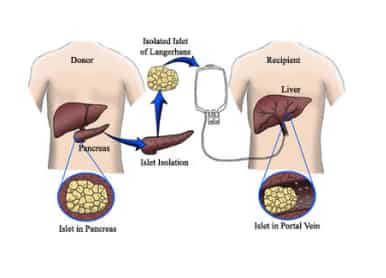
Donor cells are removed by a injection from the donor. Then
Centrifuged and placed in a infusion running into the liver. As simple as a injection and diabetes is gone.
TGA