|
Scientists
from the Rosalind Russell Medical
Research Center for Arthritis (RRAC)
teamed up with the UCSF Planned
Giving Program to present a luncheon
on Oct. 30 to increase awareness of
UCSF’s leadership in the field among
estate planners.
RRAC Director
Ephraim P. Engleman, MD,
immunologist/rheumatologist Arthur
Weiss, MD, PhD, rheumatologist David
Wofsy, MD, and RRAC board member L.
Holly Smith, MD, shared their
insights. The support of the RRAC,
they say, has spurred significant
progress.
Engleman and
Smith, whose combined tenure at UCSF
is more than 100 years, gave
background about the advancements in
the Division of Rheumatology at UCSF.
“It’s been one of the most effective
specialty units at UCSF in carrying
through basic science into human
application.”
 |
|
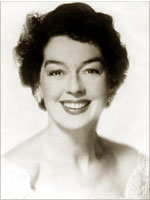
Rosalind
Russell |
Weiss reported on the role of
genetics in autoimmune diseases,
specifically on the research of
genetic epidemiologist Lindsey
Criswell, MD. In September, the
New England Journal of Medicine
published her studies, part of a
multicenter study, which identified
a critical gene that increases a
person’s risk for rheumatoid
arthritis and systemic lupus.
In Weiss’ own
lab, he and his team are altering
genes in mouse models to identify
which combinations of genes lead to
lupus. “By understanding the
combinations that lead to lupus,
maybe we’ll have better targeted
therapy,” he said.
“Over the
years, tremendous progress has been
made in immunology and
biotechnology,” said Wofsy, “which
has helped us to understand the
chain of events that causes
inflammation, pain and joint
destruction in patients with
rheumatoid arthritis.” In the late
1990s, UCSF contributed to a major
breakthrough in development of a
drug for rheumatoid arthritis.
Now, Wofsy is
involved in running clinical trials
of several therapies for systemic
lupus, and has high hopes that at
least one will be effective. “I
think soon there will be the first
biologic therapy in lupus. It’s a
very exciting time,” he said.
Weiss and Wofsy attributed such
successes in part to collaboration
among UCSF immunologists and
rheumatologists with scientists at
other universities. “There’s a lot
of cross-fertilization and
collegiality that has been built,”
Weiss said. “Our basic science and
our clinical science have now come
together. Both pieces form the whole
and, of course, that’s where you
always hope to be – where science is
relevant to human disease.”
The US
Congress created the Rosalind
Russell Medical Research Center for
Arthritis, which was awarded to UCSF
in 1979. The center is named after
actress Rosalind Russell, who
developed rheumatoid arthritis in
the 1960s. Frustrated that doctors
knew very little about arthritis,
she successfully lobbied Congress to
pass the National Arthritis Act.
After she died, the center was
established. |