Anxiety Rx
Search Cidpusa webLimbic encephalitis
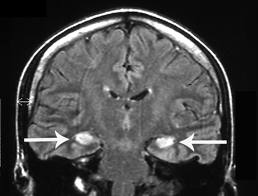
Limbic encephalitis presenting
as delirium in a patient who
underwent bone-marrow transplant
for non-Hodgkin lymphomaCoronal
MRI shows high signal (white)
bilaterally in the temporal
lobes in the areas corresponding
to the hypocampal uncus. The
surrounding white matter shows
oedema (arrows). The CSF
examination confirmed diagnosis
of herpes 6 virus encephalitis.
By David Douglas
NEW YORK (Reuters Health) Oct 10 - Limbic encephalitis may often be a precipitating event in adult-onset temporal lobe epilepsy, according to German researchers.
Limbic encephalitis, lead investigator Dr. Christian G. Bien told Reuters Health, "is protracted brain inflammation, probably of autoimmune origin, which is sometimes a corollary of malignant diseases outside the nervous system, but may also occur without apparent cause."
In the September 18th issue of Neurology, Dr. Bien of the University of Bonn and colleagues note that temporal lobe epilepsy with hippocampal sclerosis usually starts in childhood or adolescence, but can manifest in adulthood. "In earlier times," added Dr. Bien, "it could only be detected by postmortem autopsies. Since the early 1990s, hippocampal sclerosis can be visualized by brain MRI in vivo."
To characterize factors associated with adult-onset disease, the researchers conducted a retrospective review of data on 38 patients with epilepsy onset at a median age of 37.8 years.
Eleven had hippocampal sclerosis due to events such as head trauma and febrile seizures, and seven were classified as being of idiopathic origin.
Nine had MRI findings typical of limbic encephalitis, and another eleven were deemed as possibly having the condition. Thus, say the investigators, about half of the patients showed evidence consistent with an autoimmune process.
Subjects in these two subgroups were significantly more likely to have bilateral abnormalities than were those without such findings.
In an accompanying editorial, Dr. Andrew G. Cole of Massachusetts General Hospital notes that the study has a number of limitations, but concludes that these results "will trigger more aggressive searches for immunomarkers in patients with focal epilepsy of unknown cause, whatever their age."
Neurology 2007;69:1236-1244.